Describe the moving task before choosing the chair
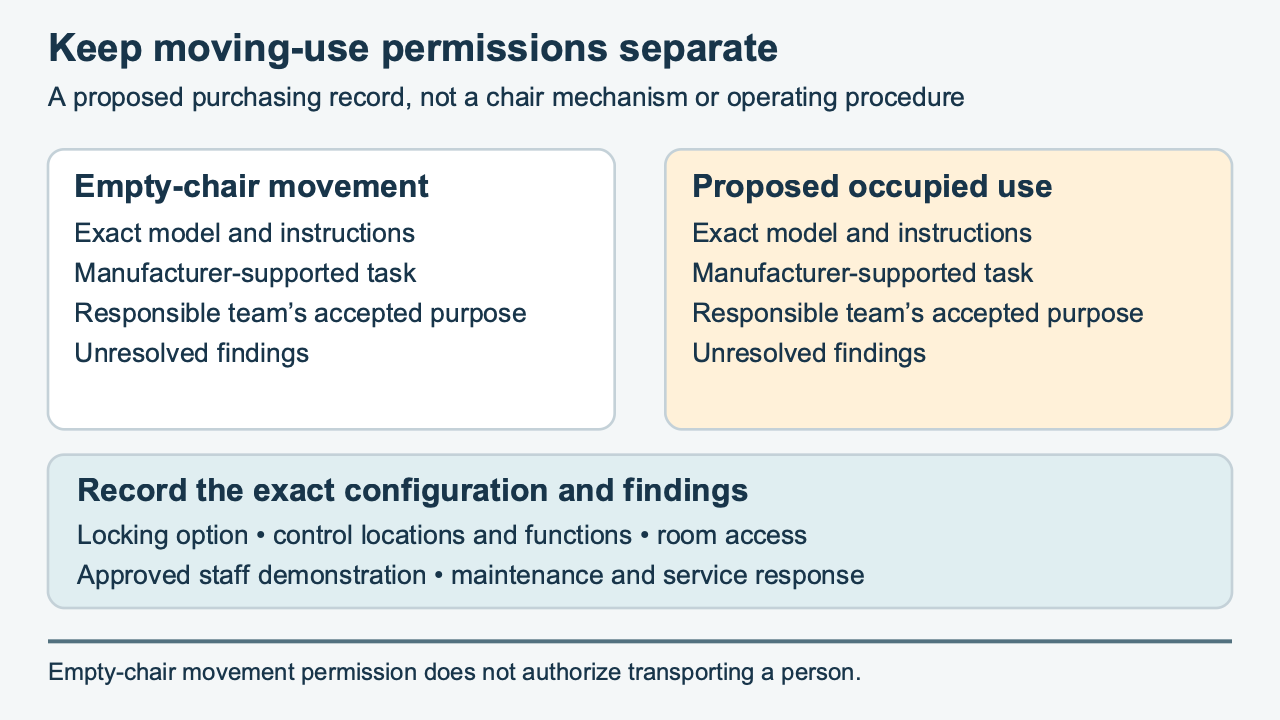
Ask the responsible care and operations staff whether the chair needs to move empty for cleaning, change position within a room or support an approved use while occupied. Keep those tasks separate in the brief. Permission to reposition an empty chair does not establish that the model is intended to transport a person.
Individual seating, transfer and support needs belong with the appropriate care professional. Begin with that team's accepted purpose and constraints; do not use a general furniture comparison to prescribe a recliner or change someone's assistance.
List the proposed starting and finishing positions, the reason for moving and who would operate the chair. If a stationary chair can serve the accepted purpose, retain it as a comparison. Mobility should resolve a defined task rather than become an accessory chosen because it is available.
Identify the exact locking configuration
Request a model reference and option list that identify the casters and locking system. Ask which wheels or functions each control locks, where the controls are reached and how the manufacturer instructs staff to confirm the intended state. Do not infer those answers from the number of visible pedals.
Global Furniture Group's Primacare overview, for example, describes Motion Recliner models with manual locking casters or four-wheel central locking casters accessible from both sides. These are different configurations within one series. The family description does not identify the controls on the specific chair in your quotation or authorize its use for a particular resident.
Have the supplier provide the applicable operating instructions and a demonstration for the exact proposed model. Keep this record separate from upholstery and finish approval. Accepting the chair's appearance should not quietly approve a different locking mechanism.
Compare controls in the places staff will use them
Draw the chair at each intended position with adjacent furniture, walls and the normal support or mobility equipment. Include its upright and extended dimensions and the clearances required by the manufacturer. Have the responsible project professional review the arrangement and access.
A control described as accessible from both sides still needs to be reachable in your actual layout. Check whether a neighboring table, wall or other furniture blocks the prescribed operating position. Ask staff to assess the controls through an appropriately supervised supplier demonstration, following the applicable instructions.
Record the findings against the exact configuration:
| Decision | Evidence needed |
|---|---|
| Permitted moving use | Written manufacturer instructions for empty movement and any proposed occupied use, kept separate |
| Locking system | Exact option, control locations, functions locked and applicable operating instructions |
| Position in the room | Dimensioned arrangement showing required clearances and staff access to controls |
| Staff operation | Responsible team's findings from the approved demonstration and any unresolved task |
| Maintenance | Specified checks, approved service route and response to a locking or caster fault |
The common-area accessibility review helps refer layout issues to the appropriate reviewer. This buying comparison does not establish a universal clearance or certify the arrangement.
Review the route under the approved moving conditions
If movement is part of the accepted task, give the supplier the actual route and floor conditions. Identify thresholds, turns, changes of surface and the destinations where the chair must be positioned. Obtain the manufacturer's limits and required assistance for the proposed use before any route trial.
Start demonstrations with the responsible staff and supplier under the approved procedure. Resident participation, if appropriate, must use the community's normal care, consent and privacy process with usual support and assistance. No one should attempt an unfamiliar transfer or move to prove that a purchase works.
Keep furniture observations in the buying record and resident information in the appropriate care records. If the manufacturer does not support the proposed task, leave that use unresolved and consider a suitable alternative with the responsible team. Adding aftermarket casters to a fixed chair is not a substitute for this review.
Agree what happens when a control or caster needs service
Ask who carries out the manufacturer's specified checks and who handles faults. Obtain current part references and identify work permitted for site staff versus work requiring approved service. Do not assume that a component can be replaced locally because another model in the family is described as repairable.
Have the community's responsible team define how a questionable chair is kept from use pending assessment and how appropriate replacement seating will be arranged. Follow the applicable fault and service instructions. A locking problem should not become an informal workaround passed from one shift to the next.
Keep the exact model, option list, operating instructions, demonstration record and supplier contact with the asset record. If the supplier proposes a substitute, repeat the moving-use, locking and layout reviews for that configuration before accepting it.
Request the reviewed configuration
Put the accepted purpose, intended positions, moving conditions and locking-system requirement in the furniture planning brief. Identify the approvals still needed and the person responsible for each. Obtain an itemized quotation for the exact configuration and applicable support arrangements.
A mobile recliner is ready for a buying decision when the responsible team understands its permitted task, controls and service process. Keep any unconfirmed use or control-access finding visible until it is resolved.
Sources and scope
These primary and research sources anchor the subject area; they do not turn every design recommendation in this article into a proven outcome. Verify current law, adopted code, licensing rules, care plans, and clinical requirements for the specific property.