Start with the current notice and its instructions
Give the response a named owner and retain the official notice, recall number and date checked. Read the affected-product description and remedy together. Identify any immediate use restriction before treating the issue as an ordinary repair or a future replacement purchase.
For a U.S. notice, use the Consumer Product Safety Commission's recall pages and the responsible company's current recall information. CPSC notes that remedy information can change as company status or availability changes. Use the applicable authority for another jurisdiction; a notice or remedy for one country should not be assumed to cover another.
Have the community's responsible safety, facilities and care staff coordinate any required change to room use or furniture. Follow the notice's instructions while questions are resolved. Do not wait for a furniture budget meeting to deal with an immediate restriction.
Match the component as well as the furniture
The New Age tip-restraint notice, recall 24-078, provides a useful example. It concerns plastic tip-restraint kits distributed by several furniture companies with clothing storage units. The plastic zip tie can become brittle or break, allowing an anchored unit to detach during a tip-over event. An apparently connected restraint therefore does not settle whether the component is affected.
The notice tells consumers to check the clothing storage unit's sticker or stamp immediately for a manufacture date of November 2019 or later. If that condition is met and the tip kit is plastic, it directs them to contact Alliance4Safety for a free replacement kit and to keep children away from the unit while waiting. It also identifies the kit's plastic zip tie, two brackets and two screws, and packaging marked “Manufactured by New Age Industries.”
Use those details with the current participating-company information and the recall contact's identification process. The example does not mean every plastic restraint or every piece from a listed furniture company is the recalled component. When identity is uncertain, send the available item evidence through the official recall process and retain the answer.
Build a room register with honest statuses
Search the community's asset and purchasing records, then arrange any needed item checks with authorized staff. Include storage, spare rooms and furniture moved during earlier renovations. Coordinate resident-owned furniture through the community's usual ownership, access, consent and privacy procedures; the operator's purchase ledger may not contain it.
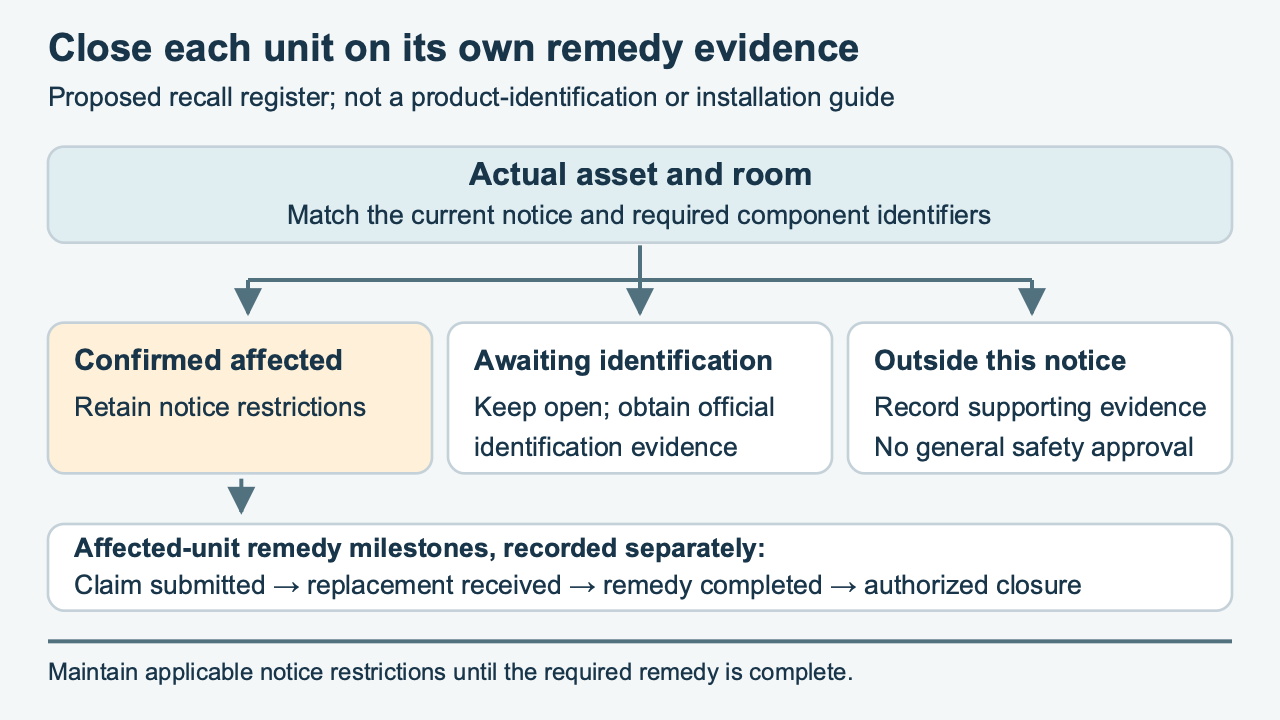
Give each actual unit a record. Several dressers ordered together can share an invoice, but each needs a location and a resolved outcome. Use statuses that distinguish confirmed affected items, items awaiting identification and items confirmed outside the notice's scope. Record who confirmed the last status and the evidence used. It is a conclusion about this recall, not a general safety approval.
| Field | What it should establish |
|---|---|
| Asset and location | Which actual piece is being checked and where it is now |
| Furniture identity | Manufacturer, model, batch or manufacture date where relevant, with record or label evidence |
| Affected component | The notice's required identifiers and any missing evidence |
| Scope status | Affected, awaiting identification or confirmed outside this notice, with the basis recorded |
| Immediate action | Applicable restriction, responsible person and confirmation it was put in place |
| Remedy progress | Official claim reference, confirmed remedy, delivery and installation status as applicable |
| Closure | Required completion evidence and the authorized person's final review |
Keep label or component photographs focused on the item. Store resident information in the appropriate restricted records rather than a broadly shared purchasing sheet.
Inspect without improvising a test or repair
Ask the responsible facilities person how the needed identifiers can be obtained under the applicable instructions. Do not have a resident move furniture, reach behind a heavy unit or test an attachment. Use qualified help when access requires moving, disconnecting or reinstalling a piece.
A hard pull on a restraint does not determine whether it is covered by a recall. It can also disturb the installation. Follow the notice and the applicable manufacturer or installer instructions; do not invent a strength test or replace the affected part with a generic component that merely looks similar.
Maintain the required restrictions while waiting for the remedy. For the New Age example, retain the notice's direction to keep children away pending replacement; the fact that the room's resident is an adult does not remove that instruction. Have the responsible team arrange the appropriate response for the actual room and visitors.
Close the remedy on the unit, not the shipment
Record a claim submitted, replacement received and remedy completed as separate events. A box arriving at reception does not establish that every affected component has been replaced. Allocate the authorized replacement to the correct asset and retain the applicable installation instructions.
Have the responsible person confirm the required work and any specified verification, with completion evidence tied to the unit. Preserve the old identity and claim record so a future check can distinguish a remedied item from an unresolved one. Do not mark all units closed from one invoice or one completed room.
Review the register's open rows until each has a supported outcome. Keep furniture awaiting identification visible, along with the official contact and next action. If another item is discovered later, add it to the same notice-based process.
Carry the evidence into the next furniture decision
Retain the resolved component and installation records with the asset's care information. If a piece must be replaced, give procurement its room requirements and the responsible team's accepted restrictions. A replacement purchase still needs its own furniture and installation review; resemblance to the old piece does not provide that approval.
Use the furniture planning checklist for any resulting purchase, while keeping the recall register with the facilities records. The record should let the next team identify the notice, find every checked unit and see the evidence that closed its particular response.
Sources and scope
These primary and research sources anchor the subject area; they do not turn every design recommendation in this article into a proven outcome. Verify current law, adopted code, licensing rules, care plans, and clinical requirements for the specific property.