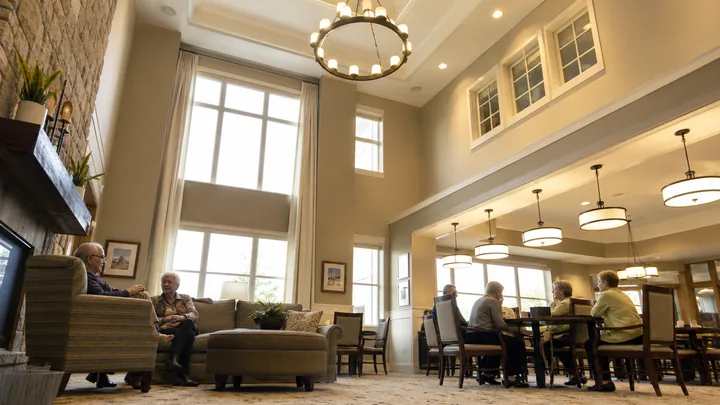
Stand in a typical senior living dining room at noon and listen. Hard floor, wipeable ceiling, big glass windows, sixty people, cutlery, carts, an ice machine, a television nobody is watching. Now add the fact that most of the people in the room have some degree of age-related hearing loss (presbycusis, one of the most common conditions of later life) and many wear hearing aids, which amplify the clatter along with the conversation.
What you are listening to is not an ambience problem. It is a social machine failing. The room exists so that people can eat together, and "together" is carried entirely on conversation. When the acoustic environment makes conversation exhausting, the room delivers calories without company, and the company was the point.
What old ears are up against

A few realities of aging hearing, stated at the level we're sure of. Presbycusis typically erodes the higher frequencies first: the range that carries consonants, which is to say the range that makes speech intelligible rather than merely audible. Separating a voice from background noise gets harder with age even when hearing thresholds look decent on paper; the "cocktail party" ability declines. Reverberant rooms, where sound bounces and smears, degrade intelligibility further, and hard-surfaced institutional rooms are reverberation engines. Hearing aids help enormously with quiet conversation and imperfectly with noisy rooms; many amplify background noise along with speech, which is why some residents remove them at meals: precisely when they need them most.
The compounding effect can be isolating. A resident who cannot follow a table conversation may participate less or leave early. That behavior has many possible causes and should never be diagnosed from the room alone, but hearing and the acoustic environment belong in the assessment. The National Institute on Deafness and Other Communication Disorders explains age-related hearing loss, its communication effects, and the value of professional evaluation.
Where the evidence stands
Well-established: age-related hearing loss is very common in this population; noise and reverberation degrade speech intelligibility, most severely for people with hearing loss; absorptive materials reduce reverberation. Discussed in the literature but beyond our lane to quantify: the links between hearing loss, isolation, and cognitive decline. Working principle: the specific design program below: it follows from the established acoustics, but we have not measured its social outcomes, and we would be suspicious of anyone who claims decimal-point precision here.
Dignity is the right frame
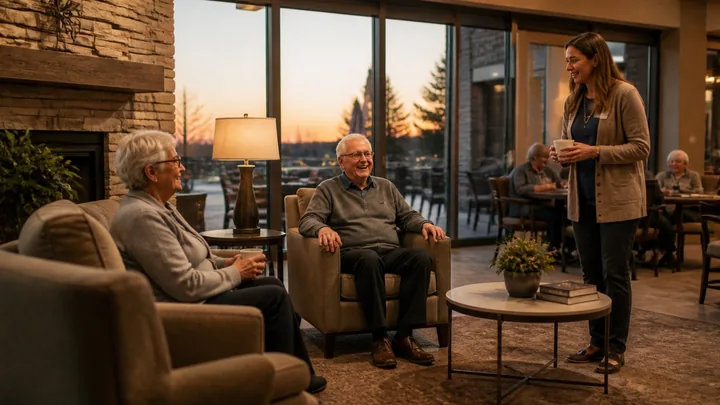
The industry tends to file acoustics under comfort, somewhere near paint colors. The better frame is dignity. Having to ask "what?" three times is a small humiliation; being talked about (over your head, at normal volume, because everyone knows you can't follow) is a larger one. A resident who can no longer participate in the life of the room has lost something the brochure promised, and the loss was avoidable. Buildings that take dignity seriously treat intelligible conversation as a service they are obliged to deliver, the way they treat hot food and safe floors.
The design moves, roughly in order of leverage

1. Absorb
Reverberation is the enemy you can buy your way out of. Every large hard surface is a candidate: acoustic ceiling treatment (the biggest single surface in the room and usually the best first move), wall panels, which now come in forms indistinguishable from framed art, and soft goods with real mass: lined curtains, upholstery, quality carpet where operations allow it. In dining rooms where flooring must stay hard for cleaning, the ceiling and walls have to do all the work; plan for that instead of accepting the clatter as fate.
2. Separate
Small rooms are quiet rooms, almost automatically: fewer competing conversations, shorter reverberant paths. This is one of the underrated acoustic arguments for breaking large common areas into smaller zones: half-walls, banquette dividers, and ceiling changes help even without full walls, though they help less than walls. A big room can also be zoned in time: staggered dinner seatings cut the number of simultaneous conversations, which is an acoustic renovation that costs a schedule change.
3. Silence the machines
Walk the room and inventory the noises no one chose: the ice machine, the HVAC rumble, the dish station with its door propped open, the cart with the shrieking wheel, the television running as wallpaper. Each is subtractable, and subtraction is cheap. The television deserves special mention: a TV on in a room where no one is watching taxes every conversation in the room. Off is a design decision.
4. Design the tables
Conversation distance is acoustic design. Across a table for four, voices carry; across a long banquet table or a ten-top, residents with hearing loss are effectively alone in company. Round tables for four to six, in a treated room, are close to optimal. This is also an argument for keeping music out of mealtimes, or, if music matters to the culture of the room, keeping it genuinely quiet and instrumental. Background music in a reverberant dining room is subtraction from every conversation at every table.
5. Provide refuge
Even a well-treated building benefits from designated quiet rooms (genuinely quiet, no TV, no music, doors that close) where a resident and a visitor can talk without competition, or where an overstimulated resident (a common need in memory care) can settle. Refuge is cheap: it is mostly a decision about what a room will not contain.
Hearing the building for the first time
Operators are habituated to their own noise floor; you stopped hearing your ice machine years ago. Two exercises recover your hearing. First, sit at the worst table at peak meal and try to follow a quiet conversation for fifteen minutes: not sample it, follow it. Note when you start leaning in and when you give up. Second, use any basic sound-level app on a phone during a normal lunch service; the absolute number matters less than the differences between your rooms and between your quietest and loudest half hour. You are not doing acoustical engineering. For renovation-grade decisions, hire an acoustician, a modest fee against a six-figure refresh. You are doing what your residents' ears do daily, and building the case for taking it seriously.
Memory care raises the stakes
Dementia can change how a person interprets or tolerates sound, but responses vary. Competing sources may distress one resident and reassure another, so the care team should observe individual responses, consider hearing assessment, and document what helps. The environmental program remains practical: reduce needless noise, add absorption, separate incompatible activities, and provide a quiet option, while preserving alarms, communication, and sounds a resident chooses. Acoustic changes can support care; they are not themselves a clinical treatment.
The cheapest renovation in the building
Ranked honestly, the acoustic program is unusual among capital projects: the highest-leverage items (turning off the wallpaper TV, fixing the cart wheel, closing the dish-room door, staggering seatings, buying quieter table arrangements) cost almost nothing and can start this week. The mid-range (ceiling treatment, wall panels, curtains) rides along with any planned refresh at modest premium, which is why acoustics belongs in every renovation scope from day one rather than as an afterthought. What you are buying, at every price point, is the same thing: the ability of two old friends to hear each other at lunch. There are few better purchases in this business.
Sources and scope
These primary and research sources anchor the subject area; they do not turn every design recommendation in this article into a proven outcome. Verify current law, adopted code, licensing rules, care plans, and clinical requirements for the specific property.